

Robotic Welding for Safe Door Panels: How Automation Improves Manufacturing Consistency
A safe door may look simple once the product is finished, but the manufacturing process behind it involves several important steps.
Before the lock, handle and internal mechanism are installed, the steel door panel has already gone through cutting, forming, positioning and welding.
In this stage of production, consistency matters.
At SHENGJIABAO, robotic welding is used for selected safe door panel operations to help improve repeatability and production efficiency.
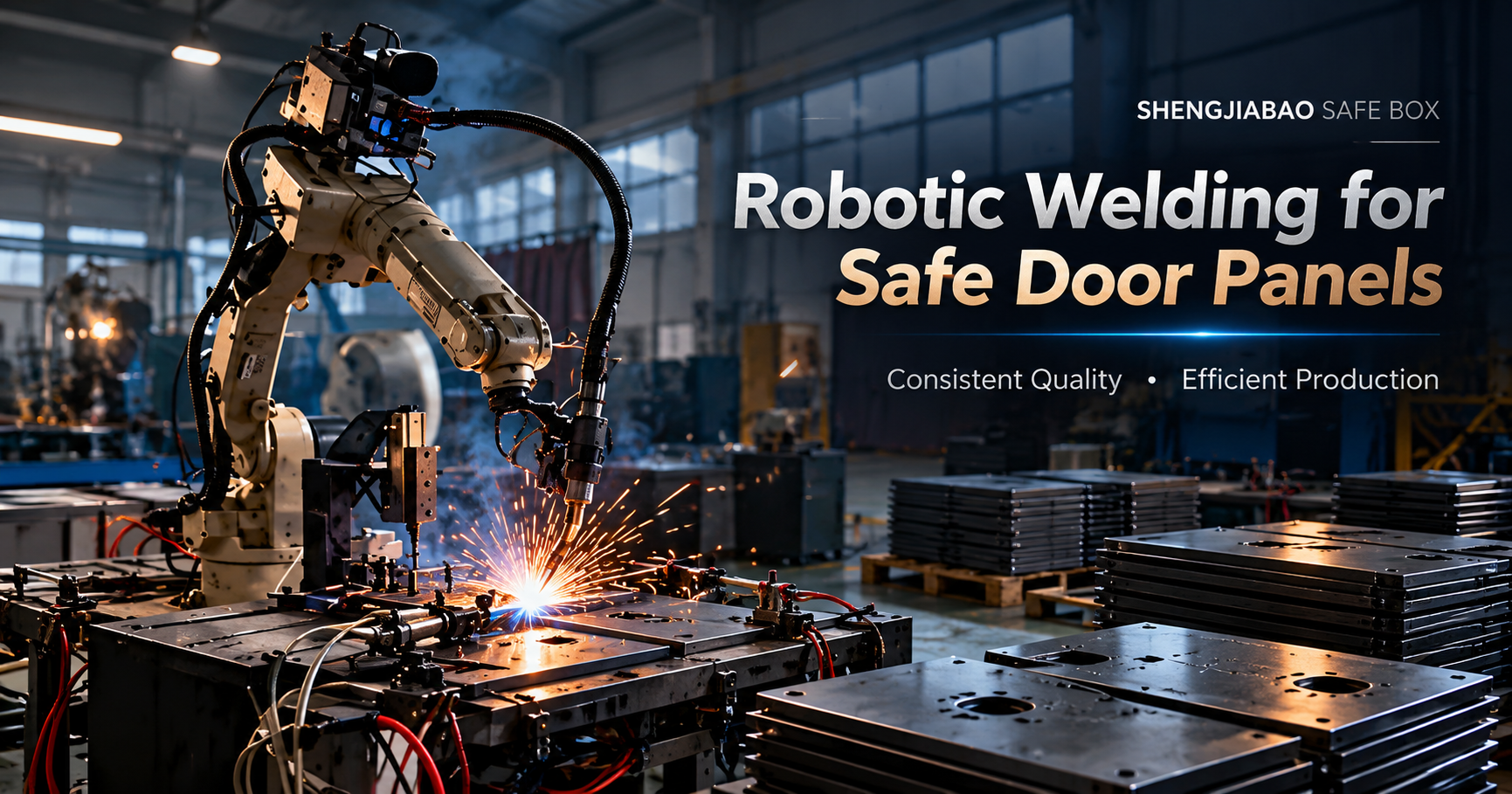
The factory video shows an automated welding robot working directly on steel safe door components. The welding path is controlled by the programmed setup, while fixtures hold the workpiece in position.
This allows the same welding process to be repeated across multiple panels with more consistent movement and timing.
For safe manufacturing, that consistency can support the quality of later production stages.
Why Welding Matters in Safe Door Manufacturing
The safe door is one of the most important structural parts of a safe.
It carries the lock system, locking bolts, handle, electronic panel and other operating components.
The steel structure behind those parts needs to remain stable.
Welding helps join and reinforce the internal door components before the product moves on to later operations.
If the welding process is inconsistent, it can affect:
- part alignment
- door structure
- later grinding and finishing
- lock component positioning
- assembly efficiency
- production consistency
That is why welding is not simply a hidden process inside the factory.
It directly supports the final assembly of the safe.
What Is Happening in the Robotic Welding Video?
The video shows a robotic welding arm working at a dedicated welding station.
Steel safe door panels are positioned on the worktable and held by fixtures.
The robot then follows the programmed welding path.
During welding, the bright arc and sparks visible in the video are created as the welding torch joins the steel components.
After one operation is completed, the part can move on to the next manufacturing stage.
The surrounding stacks of steel door panels also show that this is part of a repeat production process rather than a one-off sample.
Watch Robotic Welding in Our Safe Factory
The video above shows our robotic welding system working on steel safe door panels, helping improve welding consistency and production efficiency before the parts move on to later manufacturing stages.
Why Use Robotic Welding in Safe Manufacturing?
Manual welding remains important in many areas of metal fabrication.
Robotic welding is especially useful when the same welding operation needs to be repeated across a larger quantity of similar parts.
For safe door production, this can help in several ways.
The robot follows a programmed path.
The travel speed remains controlled.
The welding position can be repeated.
The workpiece is held in a fixed position.
Together, these factors help reduce unnecessary variation between one panel and the next.
More Consistent Weld Positioning
One of the main advantages of robotic welding is repeatability.
Once the fixture and welding program are correctly set, the robot can repeat the same movement across multiple door panels.
This is useful for batch production.
A distributor ordering hundreds of safes does not only care whether the first sample looks good.
The customer also expects the later units to remain consistent with the approved sample.
Stable welding helps support that goal.
Improved Production Efficiency
Robotic welding can also improve production efficiency for repetitive welding operations.
Once the system is prepared, the robot can continue following the programmed process without manually repositioning the torch for every weld.
This can help reduce cycle variation and make production planning more predictable.
For larger orders, that matters.
A safe factory needs to balance several production stages at the same time:
- steel cutting
- bending
- welding
- grinding
- surface finishing
- lock assembly
- final inspection
- packing
If one stage becomes unstable, the entire production flow can slow down.
Automation can help make repetitive welding work more controlled.
Stable Preparation for the Next Manufacturing Stage
Welding is not the end of the process.
After the steel components are joined, the door panel usually moves to later operations.
Depending on the design, these may include grinding, surface preparation, coating, hardware installation and lock assembly.
If the welded parts are more consistent, the next stage starts from a more predictable condition.
That can make later production easier to manage.
For example, grinding operators can work with similar weld locations.
Assembly workers can expect internal components to remain in the intended position.
This is one reason manufacturing quality depends on the connection between different processes.
Robotic Welding Does Not Replace Process Control
Automation is useful, but the robot itself is not enough.
Good robotic welding still depends on:
- correct product drawings
- accurate steel parts
- suitable welding fixtures
- correct programming
- stable welding parameters
- regular equipment maintenance
- operator supervision
- final inspection
If the steel parts entering the welding station are inaccurate, the robot cannot solve every problem.
The same is true if the fixture is incorrect.
That is why robotic welding works best as part of a complete manufacturing system.
From Laser Cutting to Robotic Welding
This welding process also connects directly with earlier production stages.
The steel parts first need to be cut to the correct dimensions.
After that, they may be bent into the required shape.
Only then can they be positioned for welding.
This is why CNC laser cutting, bending and robotic welding are closely related.
Accurate cutting supports accurate forming.
Accurate forming supports better positioning.
Better positioning supports more consistent welding.
The final product is the result of all these steps working together.
Why Safe Door Panels Need Good Dimensional Control
Safe doors contain more functional parts than many people realize.
Depending on the model, the door may include:
- electronic lock components
- mechanical lock parts
- handles
- locking bolts
- reinforcement plates
- internal linkages
- mounting brackets
- emergency key components
These parts need defined positions.
If the steel structure is distorted or inconsistent, later assembly can become more difficult.
This is one reason weld control is important.
The goal is not simply to join two pieces of steel.
The goal is to create a stable door structure that can support all later components.
Robotic Welding for Batch Production
For repeated production, robotic welding can offer a practical advantage.
The system can repeat the same programmed movement many times.
This helps reduce differences between operators and shifts.
For B2B buyers, this is important because production orders often involve hundreds or thousands of units.
A stable welding process supports more consistent output across the batch.
That consistency can make later quality inspection more efficient as well.
Safe Manufacturing Is a Connected Process
A finished safe passes through many manufacturing stages.
Each stage affects the next one.
A typical production route may include:
- steel sheet preparation
- CNC cutting
- bending
- welding
- grinding
- surface treatment
- powder coating or finishing
- lock installation
- assembly
- inspection
- packing
Robotic welding is one part of this complete chain.
It is important because the door structure connects directly with the lock system and final operation of the safe.
Supporting OEM and ODM Safe Projects
Different customers may require different safe door designs.
An OEM project may involve changes to:
- electronic lock panels
- handle positions
- locking bolt arrangements
- door thickness
- reinforcement structure
- mounting holes
- internal mechanisms
These changes can affect the welding layout.
For this reason, flexible manufacturing capability is valuable.
Robotic welding can support repeated production once the design, fixture and welding path are confirmed.
This is especially useful for customers developing private-label safe products for different markets.
Manufacturing for Different International Markets
SHENGJIABAO supplies customers serving Europe, South America, Asia, North America and other regions.
Different markets may require different product structures and lock configurations.
Some customers focus on compact home safes.
Others need office safes, deposit safes, key cabinets or commercial security products.
The production process needs to support these different designs while maintaining stable manufacturing quality.
Robotic welding is one of the technologies that helps us manage repeated steel fabrication work more consistently.
Why Factory Process Videos Matter to B2B Buyers
A finished product photo shows the final result.
A factory video shows what happens before that result.
For overseas buyers, production videos can provide useful context.
They show:
- the actual equipment
- the real production environment
- the steel components
- the manufacturing process
- the level of automation
- the scale of batch production
A short robotic welding video may only show one stage.
But that stage helps buyers understand how the product is being made.
For a B2B customer, this kind of transparency can be useful when evaluating a supplier.
SHENGJIABAO Safe Box Manufacturing
SHENGJIABAO manufactures safe boxes and related steel security products for overseas customers.
Our production process includes multiple metalworking and assembly operations, including:
- CNC laser cutting
- sheet metal forming
- robotic welding
- manual welding
- grinding
- surface finishing
- powder coating
- lock installation
- assembly
- inspection
- packing
We also support OEM and ODM projects for distributors, importers, retailers and private-label customers.
The robotic welding process shown in this video is one part of that complete manufacturing workflow.
Precision Starts Before Final Assembly
When customers look at a finished safe, they usually notice the lock, the handle and the exterior finish first.
But the quality of the product is influenced much earlier.
The steel needs to be cut correctly.
The parts need to be formed correctly.
The door components need to be welded correctly.
Only after that can the product move into finishing and assembly.
Robotic welding helps make repetitive door panel operations more consistent and efficient.
It is not the only factor in safe manufacturing quality.
But it is an important part of building a stable production process.
For distributors, importers and private-label customers looking for an experienced safe manufacturer, SHENGJIABAO can support OEM and ODM projects based on different product structures, lock configurations and target markets.
Frequently Asked Questions About Robotic Welding in Safe Manufacturing
What is robotic welding used for in safe manufacturing?
Robotic welding can be used to join steel components used in safe doors, safe bodies and other repeated structural parts.
Why use robotic welding for safe door panels?
Safe door panels often require repeated welding operations. Robotic welding helps improve repeatability, positioning consistency and production efficiency.
Is robotic welding better than manual welding?
The two methods are suitable for different applications. Robotic welding is especially useful for repetitive, standardized operations, while manual welding remains useful for flexible or lower-volume work.
Does robotic welding improve safe quality?
Robotic welding can help improve welding consistency, but final product quality also depends on cutting, bending, fixtures, finishing, assembly and inspection.
Can robotic welding reduce production variation?
Yes. Because the robot follows a programmed path, it can reduce unnecessary variation in repetitive welding operations.
What happens after robotic welding?
The parts may move to grinding, surface preparation, coating, hardware installation, lock assembly and final inspection.
Can robotic welding be used for OEM safe production?
Yes. Once the product design, fixture and welding program are confirmed, robotic welding can support repeated OEM production.
Is robotic welding suitable for different safe models?
Yes, but the fixture and welding program may need to be adjusted according to the product structure.
Does SHENGJIABAO provide OEM and ODM safe manufacturing?
Yes. SHENGJIABAO works with overseas importers, distributors and private-label customers on OEM and ODM safe projects.
Why is welding important for the safe door?
The safe door supports the lock system, locking bolts, handle and internal structure. Stable welding helps maintain the intended door structure for later assembly.
Post time: Oct-16-2026