

Set the Fixture, Start the Program: A Closer Look at Robotic Welding for Safe Door Panels
Robotic welding may look simple from the outside.
A steel part is placed on the welding table, the robot moves into position, the arc starts, and the weld is completed automatically.
But the part that makes this process repeatable actually begins before the robot starts moving.
The door panel must first be positioned correctly. The fixture has to hold it in the intended location. The welding path has to match the part. Only after those conditions are ready can the robot repeat the same sequence from one panel to the next.
This is exactly what can be seen in our latest production video.
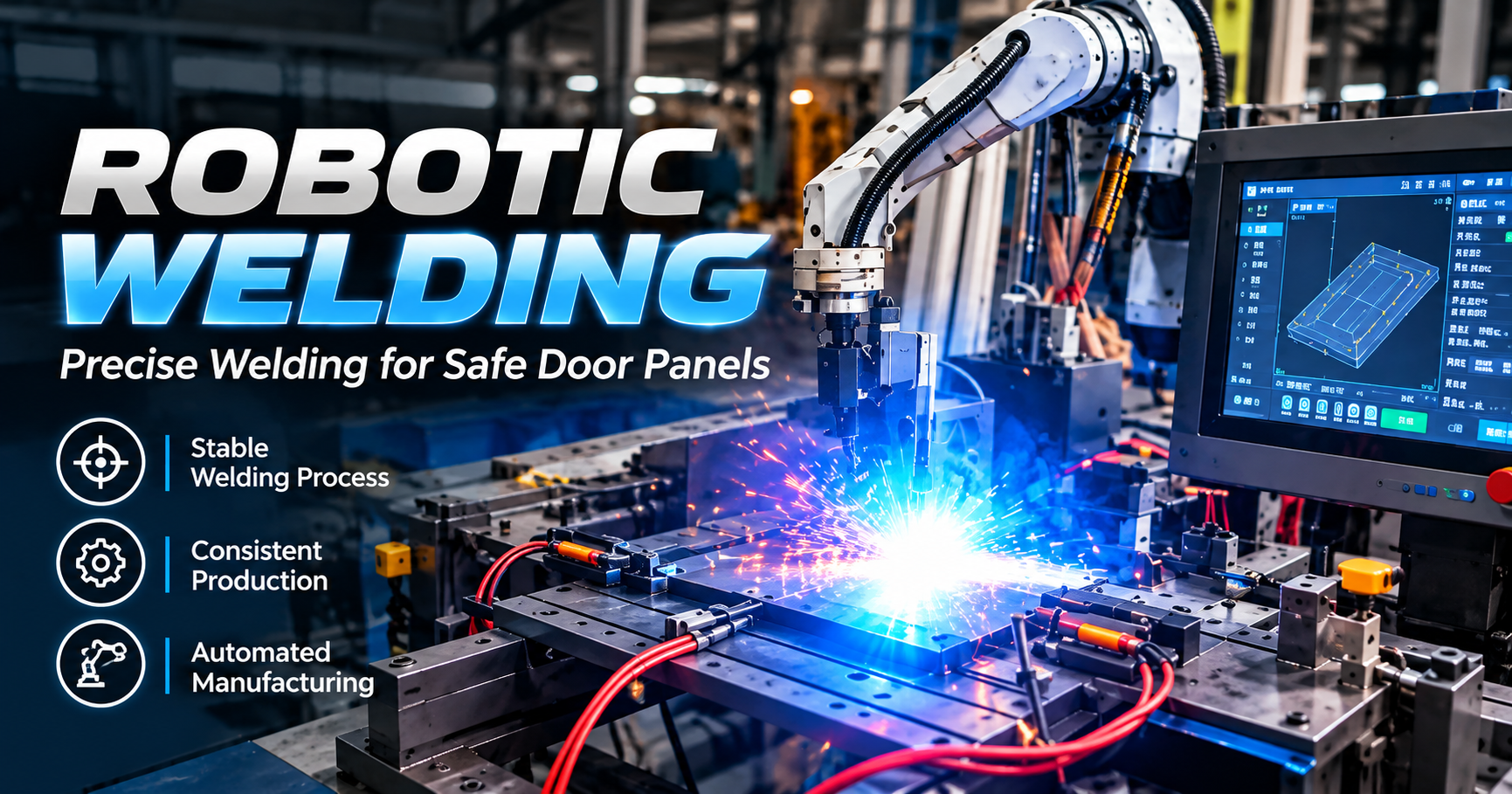
Rather than showing only the welding arc, the video takes a closer look at the complete robotic welding process for safe door panels, including the fixture, robot movement, welding sequence and operating screen.
The idea is straightforward:
Set the fixture. Start the program. Let the robot do the repetitive work.
Robotic Welding Starts with the Fixture
The welding robot is only one part of the system.
Before welding begins, the safe door panel needs to be placed in a defined position and held there securely.
This is the role of the welding fixture.
A fixture does more than stop the part from moving. It determines where the component sits in relation to the robot and therefore where the programmed welding path will meet the steel.
For repeated manufacturing, this is especially important.
The robot does not look at each door panel the way an experienced manual welder might and decide where the weld should go. It follows the programmed movement it has been given.
If the part is positioned correctly, that repeatability becomes an advantage.
The same path can be followed again and again.
That is why stable fixturing is one of the foundations of robotic welding.
Position First, Then Let the Robot Work
In manual welding, an experienced operator can often compensate for small differences in positioning.
The torch angle can be adjusted.
The operator can move slightly to follow the actual joint.
Robotic welding works differently.
The system is built around repeatability.
Once the door panel is fixed into the correct position, the robot can move through the programmed sequence without constantly changing its approach.
For repetitive safe door production, this creates a more controlled process.
The operator is still important, but the task changes.
Instead of manually guiding the welding torch through every joint, the operator prepares the workpiece, confirms the fixture, checks the program and monitors the cell.
Once those conditions are correct, the repetitive welding movement can be handed over to the robot.
The Welding Path Is Programmed in Advance
Another important detail shown in the video is the operating screen.
The welding robot does not simply move randomly from one position to another.
Its movements are based on a defined program.
The system knows where the weld starts, where the torch needs to travel and where each welding operation ends.
The sequence can then be repeated on the next part.
This is one of the reasons robotic welding is well suited to repeated production.
Instead of rebuilding the process for every individual door panel, the same validated sequence can be reused when the product structure remains the same.
For manufacturers, this makes the welding process easier to organize.
For B2B buyers, it also helps explain why repeat production can remain more consistent across a batch.
The Operating Screen Makes the Process Visible
The control interface shown in the video is an important part of the welding cell.
It provides the operator with a view of the system status and programmed process.
The exact interface depends on the equipment, but the principle is the same: the robot is not operating as an isolated mechanical arm.
It is part of a controlled system.
The operator can monitor the programmed movement, machine status and production process while the welding is taking place.
This is particularly useful when running repeated parts.
If a production issue appears, the operator has a clearer reference point for checking the welding sequence and system operation.
Automation works best when the process is visible and controlled rather than treated as a black box.
Watch the Robotic Welding Process in Detail
This video gives a closer look at the robotic welding process for safe door panels, including fixture positioning, the programmed welding path, robot movement and the operating screen showing the system in action.
Once the door panel is positioned correctly and the welding program is ready, the robot can repeat the same welding sequence from one part to the next. This is where stable fixturing and programmed automation become especially valuable in repeated production.
Why Repeatability Matters in Safe Door Production
A safe door contains several structural and functional components.
Later in production, it may need to carry:
- lock components
- locking bolts
- handles
- internal linkage parts
- reinforcement plates
- electronic panels
- mounting brackets
The steel structure created during earlier manufacturing stages therefore matters.
If welded components shift from one unit to another, later assembly can become more difficult.
A more repeatable welding process helps create a more predictable starting point for the next manufacturing stage.
This does not mean welding alone determines the quality of the finished safe.
Cutting, bending, fixture accuracy, surface finishing, lock assembly and inspection all remain important.
But welding sits in the middle of that chain.
When this stage is stable, the processes that follow are easier to control.
From Cutting and Forming to Welding
Robotic welding depends heavily on the quality of the parts that arrive at the welding station.
Before a safe door panel reaches the fixture, the steel has already passed through earlier processes.
These may include laser cutting, punching and bending.
If the parts are cut or formed inconsistently, the welding fixture cannot completely correct those differences.
That is why metal fabrication should be viewed as one connected process rather than a collection of unrelated machines.
The sequence is usually closer to:
accurate cutting → controlled forming → stable positioning → repeatable welding → grinding and finishing → assembly
Each stage creates the conditions for the next one.
The robot becomes most effective when the parts entering the welding cell are already consistent.
Stable Welding Helps the Next Production Stages
After welding, the safe door is still far from finished.
The welded structure may continue through grinding, surface preparation, powder coating, hardware installation and final assembly.
Consistent welding can make those later stages easier to manage.
For example, if welded components remain in similar positions across a production batch, assembly workers do not need to compensate for unnecessary variation.
The same applies to grinding and surface finishing.
A controlled welding sequence helps create more predictable work for the operations that follow.
This is where automation becomes valuable beyond the welding station itself.
The benefit is not only that the robot performs the weld.
It also supports a more stable production flow.
Repetitive Work Is Where Robotic Welding Makes Sense
Not every welding job needs to be automated.
For one-off parts, frequent design changes or highly variable assemblies, manual welding can remain more flexible.
Robotic welding becomes particularly useful when similar parts need to be produced repeatedly.
Safe door panels are a good example.
Once the product structure, fixture and welding program are confirmed, the same operation can be repeated across the batch.
The robot does not get tired halfway through a shift.
It does not gradually change its movement because the work is repetitive.
The programmed path remains the reference.
This makes robotic welding a practical tool for standardized production.
Automation Does Not Mean “No Operator”
One common misunderstanding about robotic welding is that the robot does everything by itself.
In reality, a stable automated process still depends on people.
Operators need to:
- position the part correctly
- check the fixture
- select or confirm the correct program
- monitor machine operation
- inspect the result
- maintain the equipment
- respond when something is outside the normal process
The difference is that repetitive torch movement no longer needs to be performed manually for every part.
The robot handles repetition.
The operator manages the process.
That is a more accurate way to understand welding automation.
Why This Matters for B2B Safe Buyers
Overseas buyers usually see the finished safe.
They see the lock, handle, powder-coated surface and packaging.
They do not always see how the steel structure was made before final assembly.
Factory process videos help close that gap.
A detailed robotic welding video shows more than sparks.
It shows how a repeated production process is organized.
For importers, distributors and private-label customers, this provides useful context when evaluating a supplier.
It helps answer questions such as:
How are repeated steel parts positioned?
How is the welding path controlled?
Is the process based only on manual work?
How is the operator monitoring the machine?
What happens before the finished safe reaches assembly?
These details can matter when a customer is evaluating long-term production rather than only a single sample.
Robotic Welding as Part of OEM and ODM Production
OEM and ODM safe projects often involve different door structures.
One customer may need a different electronic panel.
Another may require another handle position, locking bolt arrangement or reinforcement structure.
Those changes can affect the welding process.
When a new structure is confirmed, the fixture and welding program may need to be adjusted accordingly.
Once the production setup is validated, robotic welding can then support repeated manufacturing of that configuration.
This is one reason manufacturing preparation matters so much in OEM projects.
The product drawing is only the beginning.
The production process also needs to be translated into workable cutting, forming, positioning and welding steps.
A Closer Look at What Makes Automation Work
The most impressive part of robotic welding is often the bright welding arc.
But the arc is only the visible part.
The real foundation is less dramatic:
a correctly made part,
a stable fixture,
a defined welding path,
a suitable program,
and an operator who knows how to manage the system.
Once those elements are ready, the robot can do what it does best: repeat the same programmed work consistently.
For safe door production, that is where automation becomes practical.
Set the fixture.
Start the program.
Let the robot do the rest.
Frequently Asked Questions About Robotic Welding for Safe Door Panels
Why is the fixture important in robotic welding?
The fixture holds the safe door panel in a defined position. Because the robot follows a programmed path, stable part positioning helps the weld path remain aligned with the intended joint.
Does the welding robot automatically decide where to weld?
The system follows a programmed welding path. The part, fixture and program need to be prepared correctly before repeated production begins.
What can be seen on the machine screen?
The operating screen allows the operator to monitor the welding system and programmed process during production. The exact information shown depends on the equipment and program.
Why is robotic welding useful for safe door panels?
Safe door panels are repeated steel components. Once the structure, fixture and welding sequence are confirmed, the robot can repeat the same process across multiple parts.
Does robotic welding replace manual welders completely?
No. Operators are still needed for part loading, fixture checks, program selection, monitoring, inspection and maintenance. Automation mainly takes over repetitive welding movement.
What happens after the safe door is welded?
The door may continue through grinding, surface preparation, coating, lock installation, hardware assembly and final inspection.
Does robotic welding improve consistency?
A programmed robot can repeat the same movement and welding sequence when the parts and fixture remain consistent. This helps reduce unnecessary variation in repetitive production.
Can robotic welding be used for OEM safe projects?
Yes. When an OEM design changes the door structure, the fixture and welding program can be reviewed and adjusted for the new configuration before repeated production.
Is robotic welding suitable for every product?
Not necessarily. It is most useful for repeated parts with a stable structure and predictable positioning. Manual welding can remain more practical for one-off or frequently changing work.
Why should B2B buyers care about the welding process?
The welding stage affects the steel structure that later supports the lock, bolts, handle and other door components. Understanding the manufacturing process helps buyers evaluate how repeat production is managed.
Post time: Oct-30-2026