

Dual Laser Cutting for Safe Manufacturing: Keeping Sheet Metal Production Moving
Laser cutting is one of the first major steps in modern safe manufacturing.
Before a steel panel can be bent into a cabinet, welded into a door structure or assembled with locks and hardware, it first has to be cut into the correct shape.
Accuracy matters, but for repeated production, capacity matters too.
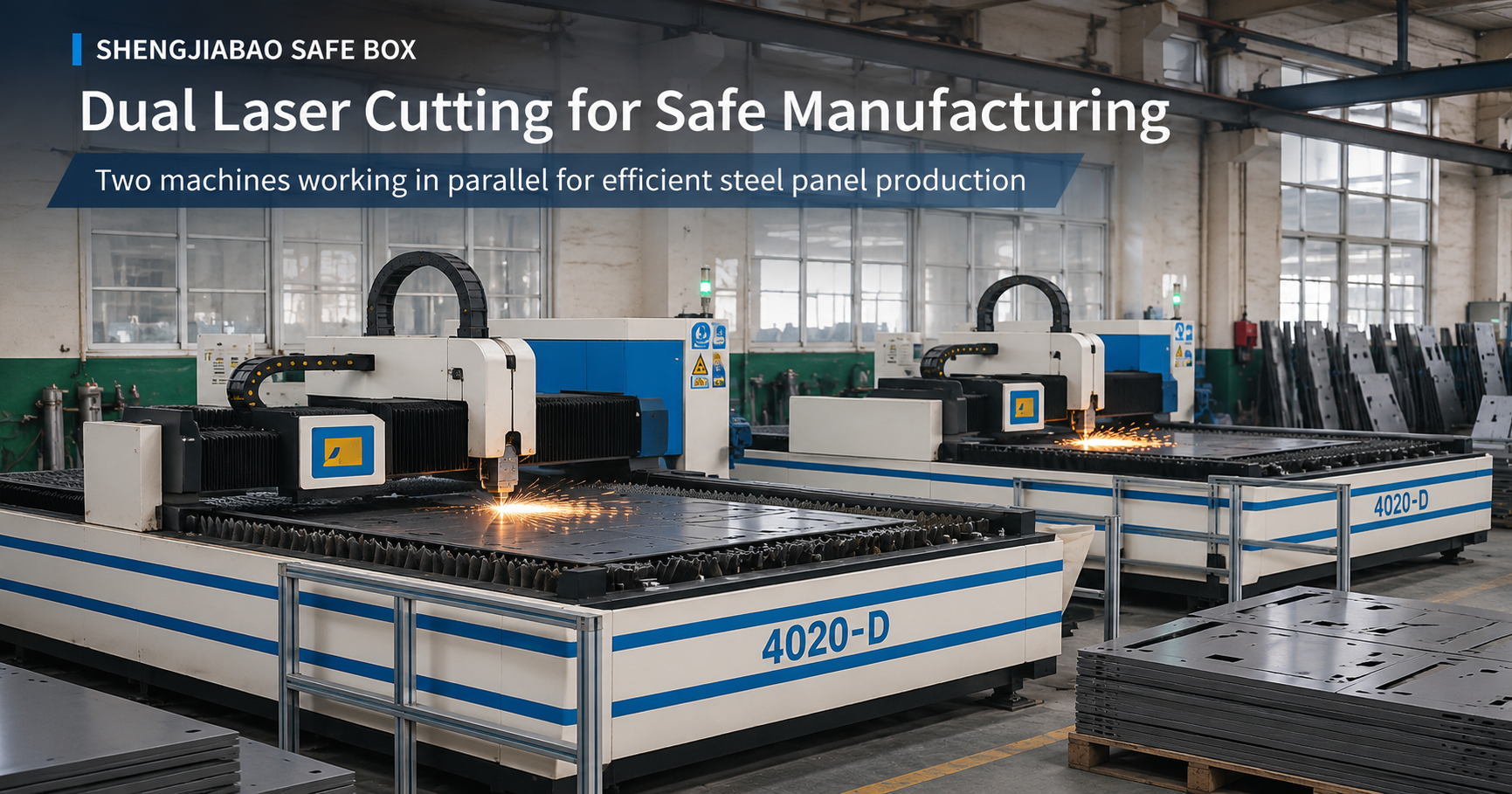
In our latest factory video, two laser cutting machines are working in parallel on sheet metal components for safe production. The machines are processing steel at the same time while completed parts are prepared for the next stages of manufacturing.
For an OEM safe manufacturer, this kind of parallel production is useful because the cutting department needs to do more than produce one accurate component. It needs to keep supplying bending, welding and assembly with enough parts to maintain a steady production flow.
Two Laser Cutting Machines Working in Parallel
The most visible feature in the video is simple: two laser cutting machines are running at the same time.
Both machines are processing steel sheets used for safe manufacturing.
This gives the cutting section more flexibility when different parts, different safe models or larger production quantities need to be handled.
One machine may be cutting door panels while another prepares body panels or internal components.
For larger batches, both machines can also support higher-volume cutting schedules.
The purpose is not simply to make the factory look busy.
The real advantage is that sheet metal production is less dependent on a single cutting station.
When more components are needed, there is more capacity available to keep material moving.
Watch Dual Laser Cutting in Production
This video shows two laser cutting machines working in parallel on steel panels for safe production. Running multiple machines helps maintain cutting capacity and keeps material moving toward bending, welding and later assembly stages.
From Steel Sheet to Safe Components
A finished safe begins with flat sheet metal.
Before bending or welding takes place, the steel needs to be cut according to the product drawing.
Depending on the safe model, laser-cut parts may include:
- safe body panels
- door panels
- internal reinforcement plates
- shelves
- mounting plates
- lock brackets
- structural parts
- internal partitions
Each component has its own dimensions, openings and mounting positions.
A safe door, for example, may require openings for a digital lock, handle, emergency key system or other hardware.
A cabinet panel may require mounting holes or slots before it is formed.
This is why sheet metal laser cutting is not just a preliminary operation. It creates the basic geometry that later manufacturing stages depend on.
Why Laser Cutting Accuracy Matters
When a steel component moves into bending, the edges and reference points already need to be correct.
When that formed part reaches welding, the components need to fit the fixture and align with the intended structure.
When assembly begins, locks, handles, bolts and internal parts need to match their mounting positions.
A dimensional problem at the cutting stage can therefore create problems much later in production.
Accurate laser cutting helps establish a more consistent starting point.
That does not mean the laser cutter alone determines final product quality.
Bending accuracy, welding fixtures, surface treatment and assembly control are equally important.
Safe manufacturing works as a connected process.
The quality of one stage affects the stage that follows.
Why Cutting Capacity Matters as Much as Precision
Precision is usually the first thing people associate with CNC laser cutting.
But for an actual production order, there is another question:
Can the cutting section supply enough components for the rest of the factory?
A batch of safes can require hundreds or thousands of sheet metal parts.
If bending operators are ready but the panels are still waiting to be cut, production slows.
If the welding section is waiting for door components, the same problem moves further down the line.
Using two laser cutting machines provides additional capacity for repeated production.
The machines can process different jobs in parallel rather than forcing every component through one cutting schedule.
For larger OEM safe orders, this helps reduce unnecessary waiting between processes.
Keeping Material Moving to Bending and Welding
Laser cutting is only the beginning.
Once steel parts are cut, many of them move directly to bending.
A flat panel may become a side wall.
Another part may become the safe door.
A reinforcement plate may remain flat but later be welded inside the structure.
After bending, those formed components move into welding.
This creates a natural production sequence:
sheet metal laser cutting → bending → welding → grinding → surface finishing → assembly
The better these stages are coordinated, the more smoothly production can move.
This is why cutting capacity has value beyond the laser cutting department itself.
Two machines working in parallel can help keep the next stage supplied with parts instead of allowing material to accumulate at one bottleneck.
Laser Cutting Safe Door Panels
Safe doors are often more complex than ordinary sheet metal panels.
They may require several openings and mounting points before the steel reaches welding and assembly.
Depending on the model, a safe door can include positions for:
- electronic keypads
- mechanical locks
- handles
- emergency key covers
- locking mechanisms
- internal brackets
- reinforcement components
Laser cutting allows these features to be created directly from the production drawing.
Once the program for a confirmed model has been prepared, the same cutting path can be repeated for future production.
For an OEM safe box project, this repeatability is important because the finished order needs to remain consistent with the approved design.
Supporting Different Safe Models
A safe factory does not always produce one cabinet design all day.
Different customers require different products.
A compact home safe uses different steel components from a hotel safe.
A deposit safe may require another door layout.
A gun cabinet, key cabinet or office safe may have completely different dimensions.
This is where CNC laser cutting provides manufacturing flexibility.
Changing from one product to another does not necessarily require a dedicated cutting die for every steel shape.
The production team can prepare a different cutting program based on the approved drawing.
This makes laser cutting particularly useful for custom safe manufacturing and OEM projects involving multiple models.
Better Flexibility for OEM Safe Manufacturing
OEM safe projects often include changes that affect sheet metal parts.
A customer may request:
- a different cabinet size
- another lock panel
- a new handle position
- additional mounting holes
- a different bolt arrangement
- internal structural changes
- customized brackets or partitions
These changes need to be reflected before the parts reach bending and welding.
Once the design is confirmed, the laser cutting program can be prepared around the new structure.
For repeated orders, that program becomes part of the production process.
This is one reason CNC laser cutting is valuable to an OEM safe manufacturer: it supports both repeatability and product variation.
Sheet Metal Fabrication Is More Than One Machine
A laser cutter can produce an accurate panel, but that panel is still only a flat piece of steel.
Safe box manufacturing requires several fabrication stages to work together.
The part has to be formed.
Structural components may need to be welded.
Welded areas may require grinding.
The cabinet then moves into surface preparation and coating.
After that come lock installation, hardware assembly, inspection and packaging.
This wider process is what turns sheet metal fabrication into a finished safe.
For B2B buyers, it is often more useful to understand the complete manufacturing flow rather than focusing on one machine specification alone.
Two Machines Add Production Flexibility
Running two laser cutting machines does not automatically mean every order will be produced twice as fast.
Production planning is more complex than that.
Different steel thicknesses, nesting layouts, product structures and batch sizes all affect cutting schedules.
The advantage is flexibility.
If one machine is occupied with a large batch, the other can continue preparing another group of components.
If several safe models are being produced, the cutting work can be divided more efficiently.
If production volume increases, the factory has additional capacity before cutting becomes the limiting stage.
This is especially useful for repeat orders where stable production flow matters more than a single fast cutting cycle.
Better Material Utilization Through Programmed Cutting
Laser cutting also allows parts to be arranged on a steel sheet according to a programmed layout.
The objective is not only to cut the required shapes but also to use the available sheet area efficiently.
Different parts can sometimes be nested together to reduce unnecessary scrap.
Material utilization is important in sheet metal fabrication because steel is a significant part of the product cost.
An efficient cutting layout therefore supports both production efficiency and material control.
The exact nesting arrangement depends on the parts being produced, but digital cutting programs give manufacturers more flexibility when planning different components on the same sheet.
What B2B Buyers Can Learn from Factory Process Videos
Finished product photos are useful, but they show only the final stage.
Factory videos provide another type of information.
They allow distributors and importers to see how steel parts are actually being processed.
In this video, buyers can see two laser cutting machines operating in the same production area and steel components being prepared in batches.
That gives more context about the factory’s sheet metal fabrication process and available cutting capacity.
For a buyer evaluating a safe box manufacturer, this kind of manufacturing evidence can be more useful than a general statement such as “advanced production equipment.”
The equipment is visible.
The material is visible.
The production process is visible.
Capacity Matters for Repeat Orders
Producing one sample and producing a commercial order are two different tasks.
A sample proves that a design can be made.
Repeated production requires the same product to move through cutting, bending, welding, finishing and assembly many times.
This is where manufacturing capacity becomes important.
The cutting stage needs to supply enough components.
The bending section needs to process them.
Welding needs to keep pace.
Assembly needs a steady flow of finished cabinets and doors.
Two laser cutting machines working in parallel help strengthen the first part of that chain.
For importers and distributors placing repeat orders, this type of capacity can be an important part of supplier evaluation.
Laser Cutting as Part of a Complete Safe Manufacturing Process
At SHENGJIABAO, laser cutting is not an isolated demonstration process.
It is part of the production sequence used to turn steel sheets into finished safe products.
The process connects with bending, welding, grinding, coating, lock installation, assembly and inspection.
This latest video focuses specifically on the cutting stage and shows two machines running in parallel.
The key point is straightforward:
accurate cutting prepares the part, while stable cutting capacity helps keep the production line moving.
For OEM and ODM customers, both are important.
A correct drawing needs to become a correct steel component.
And that component needs to be produced consistently across the required quantity.
From Two Laser Cutters to One Continuous Production Flow
Two machines working side by side may look like a simple factory scene.
But behind that scene is a basic manufacturing principle.
Production works best when every stage has the capacity to support the next one.
Laser cutting prepares the components.
Bending forms them.
Welding builds the structure.
Finishing prepares the surface.
Assembly brings the safe together.
When cutting capacity remains stable, material can continue moving through that sequence.
For a safe box manufacturer serving overseas OEM and private-label customers, that production flow is just as important as the performance of any single machine.
Frequently Asked Questions About Laser Cutting in Safe Manufacturing
Why is laser cutting used for safe manufacturing?
Laser cutting prepares sheet metal components with defined dimensions, openings, holes and slots before the parts move into bending, welding and assembly.
What safe components can be laser cut?
Laser cutting can be used for safe body panels, door panels, reinforcement plates, shelves, brackets, partitions and other sheet metal components.
Why are two laser cutting machines useful?
Two machines provide additional production flexibility and help the cutting section handle different jobs, product models or larger production quantities at the same time.
Does laser cutting improve safe door accuracy?
Laser cutting helps prepare door panels with consistent outlines and mounting openings. Final accuracy also depends on bending, welding, assembly and other manufacturing stages.
What happens after laser cutting?
Depending on the component, the part may move to bending, welding, grinding, coating or another fabrication stage before final assembly.
Can laser cutting support custom safe manufacturing?
Yes. Once the custom safe design is confirmed, cutting programs can be prepared for the required sheet metal components.
Is CNC laser cutting suitable for OEM safe projects?
Yes. CNC laser cutting is useful for OEM production because programmed cutting paths can support both customized designs and repeated production.
Does using two machines guarantee a shorter delivery time?
Not by itself. Total lead time also depends on material availability, bending, welding, coating, assembly, inspection, packaging and the complexity of the order.
Why is sheet metal fabrication important when choosing a safe manufacturer?
The safe body and door are built from fabricated steel components. Cutting, bending and welding capability directly affect how efficiently those components can be produced and assembled.
What should importers consider when evaluating an OEM safe manufacturer?
Buyers can look at product quality, manufacturing processes, equipment capacity, repeat production capability, quality control, customization support and communication throughout the project.
Post time: Nov-06-2026