
How Laser Cutting Improves Precision in Safe Box Manufacturing
A finished safe may look simple from the outside: a steel cabinet, a door, a lock and an internal storage space.
But before any of those parts are assembled, the manufacturing process begins with something much more basic — a flat sheet of steel.
How accurately that steel is cut affects almost every production step that follows.
At SHENGJIABAO, CNC laser cutting is used as part of our steel processing workflow to produce the individual sheet-metal components required for safe bodies, doors and other structural parts.
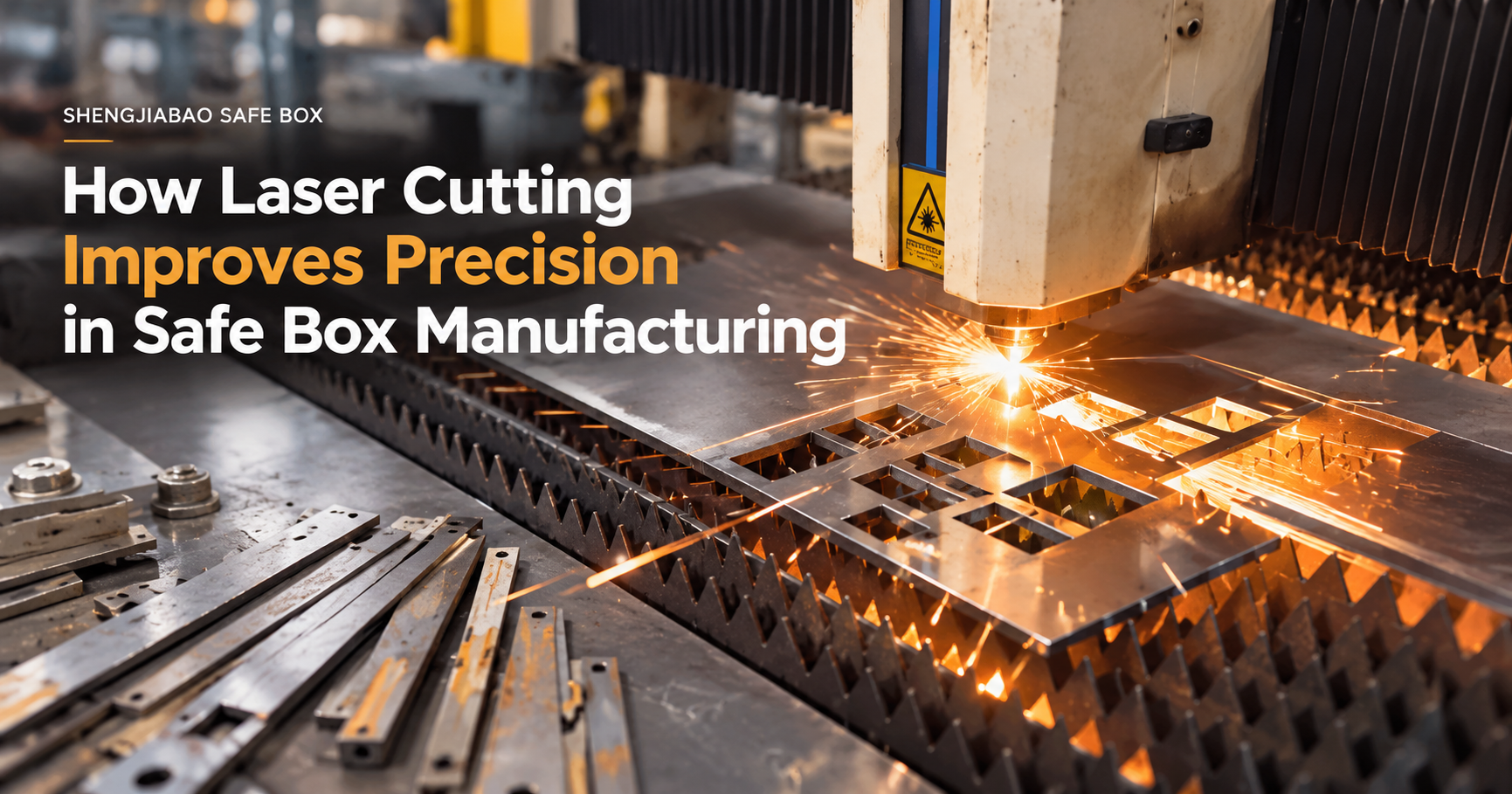
The short factory video from our production floor shows this process in action. A programmed laser cutting head follows the required geometry across the steel sheet, creating the openings, edges and individual components that will later move through bending, welding, finishing and assembly.
It is only one stage in safe box manufacturing, but it is an important one.
A Safe Starts as a Flat Steel Sheet
Before a safe becomes a three-dimensional cabinet, its major steel components have to be produced from flat sheet material.
Depending on the safe design, these parts may include:
- cabinet panels
- door panels
- internal reinforcement pieces
- lock mounting areas
- bolt mechanism components
- electronic panel openings
- fixing brackets
- internal structural parts
Each component eventually has to fit together with other parts.
If a panel is cut incorrectly at the beginning, the problem does not disappear later in production. It can affect bending positions, welding alignment, door fit or the location of hardware during assembly.
That is why precision sheet metal fabrication matters long before a safe reaches the assembly line.
What Is Happening in Our Laser Cutting Video?
The video shows a steel sheet positioned on the cutting bed of a CNC laser cutting machine.
The cutting head moves according to a programmed production file, following the required outlines and openings for the parts being manufactured.
When the laser reaches the steel, the concentrated cutting energy produces the bright sparks visible in the video.
The machine continues along the programmed path until the required shapes have been separated from the sheet.
Once cutting is complete, those steel components can proceed to the next stage of production.
Unlike a finished safe video, there is not much to “demonstrate” from a consumer perspective.
The value of this process is in the accuracy and repeatability of the parts it produces.
Watch CNC Laser Cutting in Our Safe Factory
The video above shows CNC laser cutting in our production process, where steel parts are cut according to programmed dimensions before moving on to bending, welding and later assembly stages.
Why CNC Laser Cutting Is Used in Safe Manufacturing
Traditional metal cutting methods still have their place in manufacturing, but CNC laser cutting offers several advantages when a factory needs to produce steel parts with different openings, dimensions and profiles.
For steel safe manufacturing, the ability to control the geometry digitally is particularly useful.
A single safe body may require different types of cuts:
rectangular openings, mounting holes, lock-panel areas, bolt-related components and structural shapes.
Laser cutting allows these features to be produced directly from the programmed design rather than relying only on simple straight-line cutting.
This gives the production team more flexibility when manufacturing different safe models.
1. More Consistent Dimensions Between Parts
Batch consistency matters in safe production.
If 100 safe bodies are being manufactured, the corresponding panels should not gradually change in size from one piece to another.
CNC-controlled cutting helps maintain the same programmed geometry across repeated parts.
That consistency becomes especially important when the components later enter bending and welding operations.
The goal is not simply to produce an individual part that looks correct.
It is to make sure the next part — and the next production batch — can be manufactured to the same specification.
2. Cleaner Preparation for Bending
After cutting, many steel components used in a safe body need to be bent into shape.
Accurate external dimensions and accurately positioned features make this process easier to control.
For example, if a side panel contains a cutout or mounting location that needs to align with another component after bending, its original position on the flat sheet matters.
Good sheet metal cutting therefore supports the next operation rather than existing as an isolated manufacturing step.
In practical factory production, each stage depends on the accuracy of the stage before it.
3. Better Alignment During Welding
Once steel parts have been cut and formed, they can be positioned for welding.
If the parts entering welding are dimensionally consistent, operators have a more predictable starting point.
This can help with:
- cabinet squareness
- joint alignment
- door-frame positioning
- reinforcement placement
- repeatability between units
Laser cutting does not replace good welding.
Likewise, good welding cannot completely compensate for poorly produced components.
The two processes need to work together.
This is why we look at safe manufacturing as a sequence rather than a collection of unrelated machines.
Why Cutting Accuracy Matters Around the Safe Door
The door area is one of the places where dimensional control becomes particularly noticeable.
The safe door needs to operate within the cabinet opening while maintaining the intended fit.
The lock, bolt mechanism and other components also have defined mounting positions.
If earlier sheet-metal components are inconsistent, small errors can accumulate.
A cut dimension may affect a bend.
That bend may affect the position of the welded frame.
The frame position may then affect final door alignment.
This is one reason manufacturing quality cannot be judged only by looking at the finished electronic lock.
The process begins much earlier.
Accurate Openings for Locks and Electronic Panels
Modern electronic safes often use keypad panels, fingerprint modules, mechanical override components or other lock assemblies mounted through the steel door.
Those parts require correctly positioned openings.
With CNC laser cutting, the required shapes can be incorporated into the programmed steel component.
This is useful when producing different electronic safe models with different panel layouts.
For OEM projects, it can also make it easier to manufacture components according to an agreed lock configuration.
The cutting program changes according to the product design rather than forcing every safe to use exactly the same front-panel geometry.
From Laser Cutting to a Finished Safe Body
Laser cutting is only the beginning.
After the steel components leave the cutting stage, a typical manufacturing route may continue through several operations.
Bending
Flat steel parts are formed into the required cabinet or structural shapes.
Welding
The formed components are joined to create the safe body, door structure and related assemblies.
Grinding and Surface Finishing
Weld areas, joints and edges are processed where necessary to prepare the cabinet for later finishing.
You may remember our previous factory video showing this grinding stage — that process actually comes later in the same production chain.
Surface Treatment and Coating
The steel cabinet is prepared and finished according to the product specification.
Lock and Hardware Assembly
Electronic locks, handles, bolts, hinges and internal parts are installed.
Inspection and Packing
The completed product is checked before final packaging.
So when customers see a finished SHENGJIABAO safe, the product is the result of many connected manufacturing operations.
Laser cutting is one of the first.
Laser Cutting and Batch Production Consistency
An overseas importer rarely purchases only one safe.
B2B orders normally involve repeated production.
That changes what “quality” means.
A single well-made sample is important, but an importer also needs the production batch to remain consistent with the approved product.
This is where controlled manufacturing processes become valuable.
A programmed cutting process can be repeated across multiple steel sheets and production batches.
Combined with bending fixtures, welding procedures, assembly controls and inspection, this helps a safe manufacturer maintain more consistent dimensions from unit to unit.
For wholesalers and retailers, that consistency can reduce avoidable variation between products reaching different customers.
Supporting Different Safe Designs
One advantage of CNC-based fabrication is flexibility.
SHENGJIABAO manufactures different categories of security storage products, and their steel components are not identical.
A compact home safe, an office safe, a deposit safe, a key cabinet or a larger commercial safe can require very different sheet-metal parts.
Instead of treating every product as the same rectangular steel box, the cutting program can correspond to the actual design of each model.
This also supports the development of new products.
When a new safe body or door configuration is created, the required steel geometry can be incorporated into the production process before later stages are finalized.
Why This Matters for OEM and ODM Safe Projects
For an OEM customer, changing a product is not always as simple as changing the logo.
A project may involve:
- a different lock panel
- revised cabinet dimensions
- different mounting openings
- internal structural changes
- different hardware
- new accessories
- a completely new safe body
All of these changes can affect the steel components.
For this reason, OEM safe manufacturing benefits from flexible sheet-metal production capability.
CNC laser cutting allows different component geometries to be manufactured according to the approved product design.
This does not mean every customization can be made without tooling or engineering work.
Some structures still require molds, fixtures or other dedicated production preparation.
But laser cutting gives the factory another level of flexibility during product development and production.
Precision Metal Fabrication Is More Than One Machine
It is tempting to show a laser cutting machine and describe it as the reason a product is “high quality.”
Manufacturing is more complicated than that.
A good cutting machine cannot compensate for incorrect drawings.
Accurate parts can still be welded incorrectly.
A well-welded cabinet can still have problems if assembly is poorly controlled.
That is why we see precision metal fabrication as a connected workflow.
The important question is not simply:
“Do you have a laser cutting machine?”
It is:
“How is the cutting process connected to bending, welding, assembly and final inspection?”
For a finished safe to remain consistent, those operations need to support one another.
What B2B Buyers Can Learn from Factory Process Videos
Product photos are useful, but they normally show only the end result.
For overseas buyers who cannot visit every factory in person, manufacturing videos provide another perspective.
They show what happens before the product reaches the packing line.
A short laser cutting video can reveal that the supplier is working with steel components inside an actual manufacturing environment.
A grinding video can show how the cabinet is being processed after welding.
An assembly video can show how locks and hardware are installed.
None of these videos alone proves every aspect of product quality.
Together, however, they help customers better understand how the factory produces the goods they are sourcing.
That is why we will continue sharing more of the actual safe manufacturing process, rather than showing only finished products.
Manufacturing for Global Safe Markets
SHENGJIABAO works with customers serving different markets, including Europe, South America, Asia and other regions.
Product requirements can vary significantly between countries.
A European distributor may require one lock configuration and packaging format, while a South American importer may prioritize another price level or safe size. Buyers in Asian markets may have their own preferences for electronic access, styling and retail presentation.
The manufacturing process therefore needs enough flexibility to support different specifications.
Laser cutting, sheet-metal forming, welding, surface finishing and final assembly all form part of that capability.
For B2B customers, the objective is not simply to purchase steel boxes.
It is to build products that fit the intended market.
SHENGJIABAO Safe Box Manufacturing
SHENGJIABAO manufactures safe boxes and related steel security products for overseas customers.
Our product range includes solutions for home, office, retail and commercial applications.
Production involves multiple metalworking and assembly processes, including:
- sheet metal cutting
- CNC laser cutting
- bending
- welding
- grinding
- surface finishing
- lock installation
- assembly
- inspection
- packing
We also work with customers on OEM and ODM projects where product configuration, branding, packaging or structural details need to be adapted to a specific market.
The laser cutting process shown in this latest factory video is one small part of that complete workflow.
But it is also where many of the steel components begin.
From Steel Sheet to Finished Safe
The sparks from a laser cutting machine make good video footage.
The more important story is what happens after the sparks disappear.
The accurately cut steel component moves to bending.
The formed part moves to welding.
The welded cabinet moves through finishing.
Locks and hardware are assembled.
The safe is inspected, packed and eventually shipped to the customer.
Every stage adds something to the final product.
That is why, at SHENGJIABAO, we believe a good safe does not start when the lock is installed.
It starts with the steel.
For distributors, importers or private-label customers looking for an experienced safe box manufacturer, contact SHENGJIABAO to discuss your product specifications, target market and OEM/ODM requirements.
Frequently Asked Questions About Laser Cutting in Safe Manufacturing
What is laser cutting used for in safe manufacturing?
Laser cutting is used to produce steel components from flat sheet material. Depending on the safe design, these may include cabinet parts, door components, lock-panel openings, brackets and structural pieces.
Why use CNC laser cutting instead of only traditional cutting methods?
CNC laser cutting is useful when parts require repeatable dimensions, holes, openings or more complex profiles. It also allows different component designs to be produced from programmed files.
Does laser cutting improve the quality of a safe?
Laser cutting can contribute to accurate and consistent steel components, but final safe quality depends on the complete manufacturing process, including bending, welding, finishing, assembly and inspection.
Does cutting accuracy affect the safe door?
Yes. The dimensional accuracy of steel components can influence later bending, welding and door-frame alignment. Errors introduced early in production can affect later assembly.
Can laser cutting be used for electronic safe lock openings?
Yes. Door components can be produced with openings according to the required electronic panel or lock configuration, subject to the product design.
Is laser cutting useful for OEM safe box production?
Yes. CNC laser cutting can support different component geometries for OEM projects when dimensions, lock openings or structural features vary between models.
What happens after laser cutting?
Depending on the part, the next stages may include bending, welding, grinding, surface finishing, lock installation, assembly and inspection.
Can laser cutting be used for different types of safes?
Yes. Different programmed components can be produced for home safes, office safes, deposit safes, key cabinets and other steel security products, depending on the design.
Does SHENGJIABAO provide OEM and ODM safe manufacturing?
Yes. SHENGJIABAO works with overseas importers, distributors and private-label customers on OEM and ODM projects involving product configuration, branding, packaging and other agreed specifications.
Post time: Oct-02-2026