

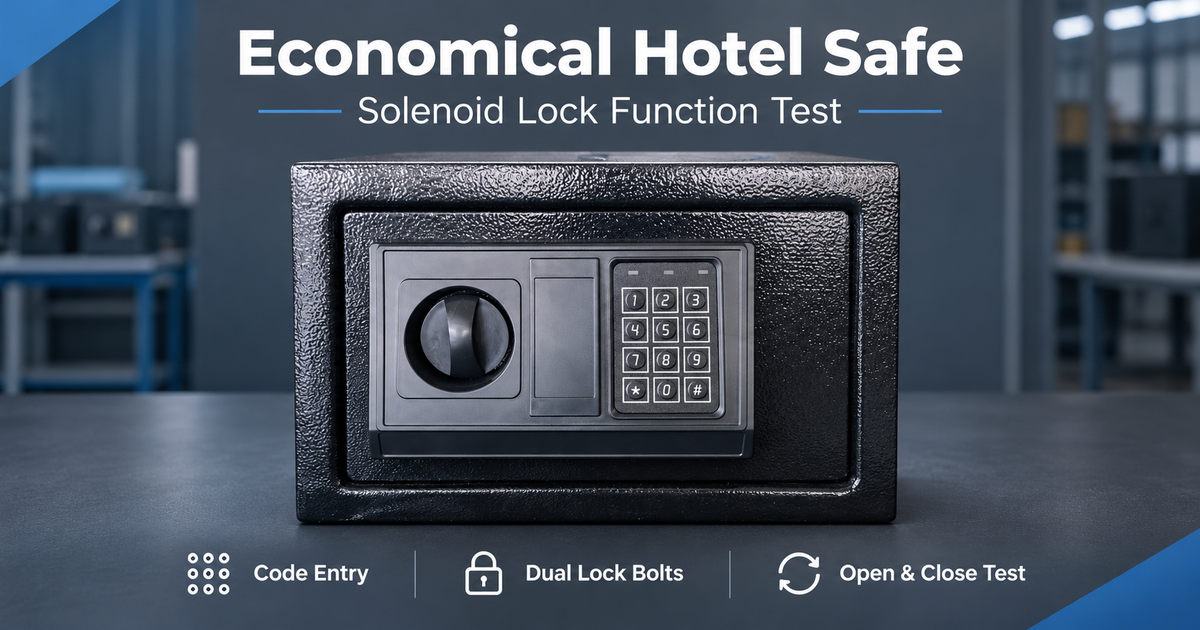
Economical Hotel Safe with Solenoid Lock: Simple Code-Based Operation for Guest Rooms
Hotel safes do not all need the same level of complexity.
Some hotel projects require audit functions, handheld management devices or more advanced electronic systems. Others simply need a compact, easy-to-understand hotel room safe that gives guests a straightforward way to lock and unlock their personal belongings.
This economical hotel safe is built around that simpler idea.
It uses an electronic keypad together with a solenoid-operated locking mechanism and dual locking catches. Both locking and unlocking require code input, creating a clear operating sequence for everyday guest-room use.
For hotels, distributors and hospitality project buyers looking for a cost-conscious electronic hotel safe, this type of configuration offers a practical balance between basic functionality, simple operation and project pricing.
A Straightforward Hotel Room Safe for Everyday Use
The main purpose of this model is simple: provide guests with a compact lockable space inside the hotel room.
The safe uses a familiar keypad layout with number keys from 0 to 9 together with * and # keys. The front panel also includes a large round operating knob, making the opening and closing process easy to understand visually.
Instead of adding functions that may not be necessary for every hotel project, the product focuses on the basic operating cycle:
enter the code,
confirm the locking action,
and enter the correct code again when access is required.
This makes the safe easy to explain in a guest-room setting and straightforward for hotel staff to demonstrate.
For economy hotels, motels, serviced apartments and other hospitality projects where simplicity and cost control are important, a basic electronic hotel safe can be a more suitable choice than a more complex system.
Solenoid-Operated Locking Mechanism
The locking system uses a solenoid-operated mechanism.
In practical terms, the electronic keypad controls the locking action. Once the correct operation is completed, the internal mechanism allows the safe to move between locked and unlocked states.
This is a common approach in compact electronic safes because it combines electronic code entry with a relatively simple internal locking structure.
For hotel projects, simplicity can be useful.
Fewer user-facing functions mean fewer steps for the guest to understand. The basic interface remains familiar: keypad, code and operating knob.
The function test video shows this process directly rather than relying only on product photographs.
Password Required for Both Locking and Unlocking
One detail of this model is that the code is used not only when opening the safe but also when locking it.
The user closes the door, enters the password and completes the locking operation.
When the safe needs to be opened again, the correct password must be entered before the door can be released.
This creates a clearly defined operating sequence.
For guests, there is less ambiguity about whether the safe has actually entered the locked state because the locking action itself is part of the code-entry process.
For hotel staff, the same sequence can be explained quickly during installation, testing or guest assistance.
Watch the Hotel Safe Function Test
This function test shows the complete locking and unlocking sequence of the economical hotel safe. The user enters the password to secure the door and enters the correct code again when access is required.
Dual Locking Catches Inside the Mechanism
The safe uses a dual-catch locking arrangement.
Although this is an economical hotel safe, the locking structure is not based on a single engagement point.
The two locking catches work as part of the internal locking mechanism when the safe is secured.
For buyers comparing different economy hotel safe designs, this is worth checking because products that appear similar from the outside can use different internal lock structures.
The external keypad may look simple, but the internal locking arrangement remains an important part of the product specification.
Why Simple Operation Matters in a Hotel Room
A hotel safe is different from a home safe used by the same person every day.
Hotel guests may only use the safe once or twice during their stay.
They may be unfamiliar with the particular model.
They may also be operating it in another language environment.
For this reason, an intuitive interface can be more valuable than adding unnecessary functions.
A simple electronic hotel safe should make the main steps obvious:
close the door,
enter the code,
lock the safe,
and enter the correct code again to reopen it.
When the operating sequence is short, hotels can also reduce the amount of explanation needed at the front desk or in the room instructions.
Compact Design for Guest-Room Installation
Hotel-room furniture often has limited space.
Safes may be installed inside wardrobes, cabinets, shelves or other furniture depending on the room design.
A compact safe is therefore easier to integrate into projects where furniture space has already been defined.
This model uses a relatively simple rectangular cabinet structure without unnecessary external features.
That makes it suitable for projects where the safe needs to remain visually discreet inside the room rather than becoming a decorative feature.
For B2B buyers, the important point is to match the safe dimensions with the available furniture opening before confirming the model.
This is particularly relevant in hotel renovation projects where the existing cabinet dimensions cannot easily be changed.
Economical Does Not Mean Complicated to Operate
The term “economical hotel safe” usually describes the product position rather than how difficult it is to use.
For this model, the goal is to keep the function focused.
There is no need to build the sales story around a long list of electronic features.
The value comes from a simpler combination:
electronic code entry,
solenoid-controlled locking,
dual locking catches,
and a compact hotel-room format.
For certain projects, that can be exactly what is required.
A buyer supplying a budget hotel chain, apartment project or entry-level hospitality range may prefer a model that controls cost while keeping the guest operation familiar.
Function Testing Before Shipment
A hotel safe needs to perform the same basic sequence repeatedly.
The keypad needs to respond.
The locking mechanism needs to engage.
The door needs to release correctly when the proper code is entered.
That is why function testing is an important part of production.
The video for this model shows a simple real-world test of the lock and unlock sequence.
The operator closes the door, enters the password, confirms the locking action and then repeats the code-entry process to reopen the safe.
This type of test may look basic, but it confirms the core function that the guest will use after installation.
For repeated production, checking the operating sequence before packing helps identify functional problems before the product reaches the customer.
A Practical Choice for Cost-Conscious Hotel Projects
Not every hospitality project needs the same specification.
A five-star hotel project may request a larger safe, laptop compatibility, management devices or more advanced access functions.
A different customer may simply need a compact electronic hotel safe for passports, cash and personal valuables.
This economical model is intended for the second type of requirement.
It gives buyers a simpler product option within a wider hotel-safe range.
For distributors, this can also help create clear product segmentation.
Instead of offering only one hotel safe at one price level, a range can include economy, standard and higher-specification models for different hotel projects.
Hotel Safe, Guest Room Safe and In-Room Safe: Different Names, Similar Use
Depending on the market, buyers may use different terms for the same product category.
Some search for an electronic hotel safe.
Others use hotel room safe, guest room safe, hotel in-room safe or simply hotel safe box.
The terminology may change, but the buying question is usually similar:
Will the safe fit the furniture?
Is the operation easy for guests?
What locking system does it use?
What functions are included?
What is the target price level?
For an economical model, clear specifications are more useful than adding unnecessary marketing language.
What Hotel Buyers Should Confirm Before Ordering
Before confirming an electronic hotel safe for a project, the buyer should first match the product to the actual room and operating requirements.
Cabinet dimensions are important.
The available furniture space should be checked before selecting the safe size.
The lock system should also match the hotel’s expectations.
Some projects may be satisfied with a straightforward code-operated model, while others require additional management functions.
Quantity matters as well.
A hotel project involving several hundred rooms has different production and packaging requirements from a small distributor order.
Providing these details early makes it easier to select the right model instead of starting with a product that may not suit the project.
OEM and ODM Options for Hotel Safe Projects
Hotel safe requirements often vary between customers.
The cabinet size may need adjustment.
The color may be different.
Branding, labels, instruction manuals and packaging may need to match the customer’s market.
For larger projects, buyers may also want to compare different lock systems or panel styles.
As a safe manufacturer working with overseas customers, SHENGJIABAO can discuss OEM and ODM requirements based on the intended project, quantity and specification.
Not every modification is automatically available on every model, so structural or electronic changes need to be reviewed before quotation.
For private-label buyers, the most useful starting point is a clear project brief including target market, quantity, required dimensions, preferred lock type and packaging requirements.
Why an Economical Model Still Has a Place in the Market
More electronic functions do not automatically make a product the better choice for every project.
Hotels operate at different price levels.
Guest expectations vary.
Furniture dimensions vary.
Purchasing budgets vary.
An economical hotel room safe can therefore remain an important part of a broader hospitality security range.
The key is matching the product to the project.
For buyers who need a compact electronic safe with straightforward password operation and a simple locking structure, this model provides a practical option without adding functions the project may not require.
Simple Function, Clear Positioning
This economical hotel safe is easy to understand because its product position is clear.
It is not intended to compete by adding every possible electronic feature.
Instead, it focuses on the functions needed for basic hotel-room storage:
a keypad for code entry,
a solenoid-operated locking system,
dual locking catches,
and password-controlled locking and unlocking.
That simplicity can be an advantage for hospitality projects where cost, ease of use and straightforward installation matter.
For distributors, hotel suppliers and OEM buyers, the next step is to match the safe dimensions and operating requirements with the intended project.
SHENGJIABAO can provide further product information, sample discussions and OEM/ODM support according to the customer’s hotel project and target market.
Frequently Asked Questions
What is an economical hotel safe?
An economical hotel safe is a simpler electronic safe designed for hotel-room use with a focus on basic functionality and cost control rather than a large number of advanced electronic features.
What type of lock does this hotel safe use?
This model uses an electronic keypad together with a solenoid-operated locking mechanism.
Does the guest need a password to lock the safe?
Yes. The user enters the password as part of the locking process.
Is a password also required to unlock the safe?
Yes. The correct password is required again when the user wants to open the safe.
What is the advantage of dual locking catches?
The dual-catch arrangement gives the locking mechanism two engagement points rather than relying on a single catch.
Is this safe suitable for every hotel project?
Not necessarily. The correct model depends on furniture dimensions, required functions, project budget and hotel operating requirements.
Can this hotel safe be installed inside furniture?
Compact hotel safes are commonly selected for installation inside wardrobes or cabinets, but the available furniture dimensions should always be checked against the actual safe size.
Can the product be customized for OEM orders?
OEM and ODM requirements such as branding, labels, manuals, packaging and certain product specifications can be discussed according to the project and order quantity.
Is this the same as a hotel room safe or guest room safe?
Yes. Buyers may use terms such as electronic hotel safe, hotel room safe, guest room safe, hotel in-room safe or hotel safe box for this general product category.
What information should a hotel buyer provide before asking for a quotation?
It is helpful to provide the required quantity, available installation space, preferred dimensions, lock requirements, target market and any branding or packaging needs.
Post time: Nov-13-2026